A few months ago I was running a sequence for a SaaS client, Open rates were solid. Clicks were decent. Replies? Nearly zero.
The usual instinct is to blame the copy. But when I dug into it I noticed something uncomfortable: a lot of them weren’t Googling at all. They were asking ChatGPT or just typing a question into Google and getting a summarized AI answer that never sent them anywhere.
That’s the GEO problem in a nutshell. And if you’re doing B2B marketing especially in a niche space it’s worth understanding before it quietly hollows out your organic funnel.
So what actually is GEO?
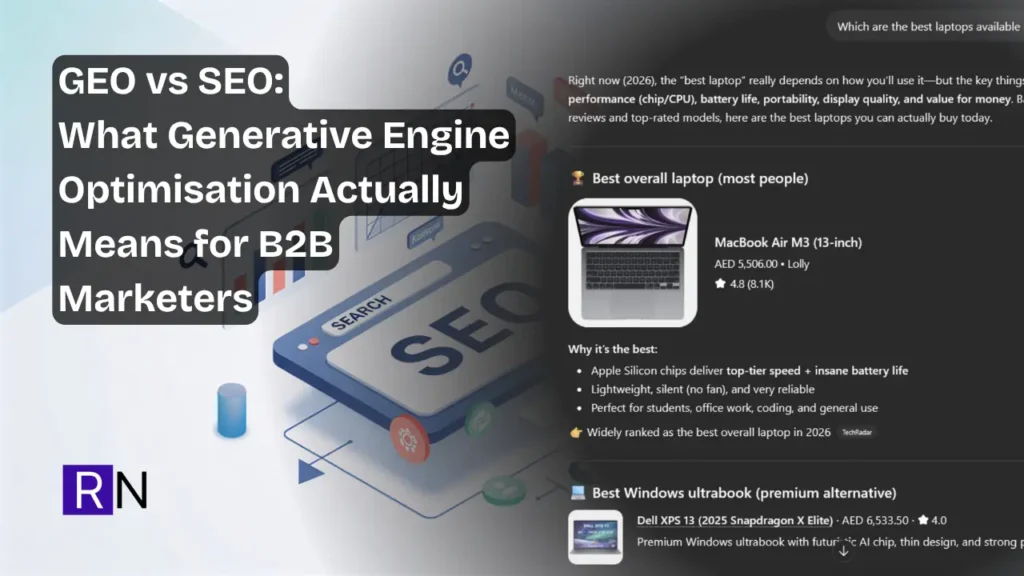
Generative Engine Optimisation (GEO) is the practice of making your content visible and citable inside AI-generated answers not just on a search results page. Think of it as SEO, but your audience is a language model deciding which sources to surface, not a human scrolling through ten blue links.
The key difference is intent. SEO is about ranking. GEO is about being referenced. When someone asks ChatGPT “what’s the best tool for visual regression testing on iOS apps,” you want your brand mentioned in that answer not just ranked #4 on Google for a keyword they may never type.
“SEO gets you ranked. GEO gets you cited. In an AI-first search world, citation is the new page one.”
The distinction matters because the mechanics are completely different. Google’s algorithm rewards backlinks, authority, and technical signals. AI models reward clarity, specificity, factual depth, and the presence of your brand across authoritative, independent sources.
Why B2B marketers should care more than anyone
Here’s the thing about B2B buyers: they do a lot of research before they ever fill out a form. Complex purchases, long sales cycles, multiple stakeholders — the whole thing. And increasingly, that research is happening inside AI interfaces, not on your website.
Recent data from SISTRIX showed that Google AI Overviews cut the click-through rate for the top organic position from 27% to just 11% in Germany. That’s a 59% drop for the #1 ranked result. If that trajectory holds globally — and there’s no reason to think it won’t — then a significant chunk of the awareness traffic that used to flow through SEO will simply stop showing up in your analytics.
For B2B specifically, this is acute. A developer evaluating CI testing tools, a CTO comparing CRM platforms, a marketing director researching automation software — these are high-intent queries, and they’re exactly the ones AI search handles confidently.
From the field: Running outreach for a B2B SaaS client in the UAE, I tested prompting ChatGPT with the exact pain points our cold emails were targeting. The AI gave a perfectly coherent answer — mentioning two competitors by name. Our client wasn’t in there. That’s not an SEO failure. It’s a GEO gap.
GEO vs SEO — the practical differences
| Factor | Traditional SEO | GEO |
|---|---|---|
| Primary goal | Rank on search results pages | Be cited in AI-generated answers |
| Algorithm | Google’s ranking system (links, authority, technical signals) | LLM training data + retrieval-augmented generation |
| Content style | Keyword-rich, structured for crawling | Clear, authoritative, answer-first |
| Key signals | Backlinks, domain authority, Core Web Vitals | Third-party mentions, press, community discussion, schema |
| Measurement | Rankings, organic traffic, CTR | Brand mentions in AI answers, share of AI citations |
| Timeline | Months | Months to years (models retrain slowly) |
The good news: GEO and SEO are not opposites. A lot of what makes content good for Google — clear structure, genuine expertise, specific and accurate claims — also makes it good for AI citation. The gap is in the distribution strategy.
What GEO actually looks like in practice
This is the part most posts skip. Let me be concrete about what I’ve been experimenting with, running campaigns across B2B clients in the UAE and internationally.
1. Write answers, not articles. AI models are looking for clear, direct responses to specific questions. If someone asks “what is visual regression testing,” your content should answer that question in the first two sentences not bury it under 400 words of preamble. Structure your content around questions your buyers actually ask, then answer them directly.
2. Get mentioned independently. This is the one SEO practitioners resist most. AI models don’t just read your site they learn from the whole web, including forums, review sites, community posts, and press. A mention of your product on a Reddit thread, a G2 review, a niche newsletter, or a podcast transcript carries real weight. Think of it as third-party validation at scale.
3. Use structured data, especially for B2B. Google has already added AI and bot labels to Forum and Q&A structured data. Schema markup that clearly defines what your product does, who it’s for, and what problems it solves gives AI systems something precise to work with. FAQ schema, HowTo schema, and Product schema are all worth implementing properly.
4. Build an owned media presence that AI can index. Syndicated press releases barely register in AI citations editorial content and owned newsrooms fare significantly better. For B2B brands this means a real blog with genuine insight, not just SEO fluff. I use n8n and local LLMs to help with research and first drafts, but the human POV and editorial layer is non-negotiable.
5. Test your brand’s AI presence regularly. Prompt ChatGPT, Perplexity, and Google AI Mode with the exact questions your buyers ask. See who shows up. If it’s your competitors and not you, that’s a content and distribution gap and it’s fixable.
A note on the UAE/MENA context
One thing I’ve noticed working in this market: the AI search transition is happening faster among tech-forward audiences here than the global averages suggest. Arabic-language AI search is maturing quickly, and multilingual buyers which describes most of the UAE B2B space are comfortable switching between AI interfaces and traditional search depending on query complexity.
If you’re doing B2B marketing in the Gulf, this means your GEO strategy should account for both English and Arabic content. A lot of the competitive white space is sitting in Arabic-language AI answers right now, simply because fewer brands are optimising for it.
The honest bottom line
GEO isn’t a replacement for SEO. It’s an additional layer and for most B2B marketers right now, it’s the layer that’s least understood and least invested in.
The brands that will win in AI-mediated search aren’t the ones with the most backlinks. They’re the ones with the clearest answers, the most credible third-party presence, and the most specific, genuine content about what they do and who they help.
If you’re already doing good content marketing, you’re probably 60% of the way there. The remaining 40% is distribution — getting your brand mentioned in the right places so the models can find you when it matters.
Start by asking an AI the question your ideal customer would ask. If your brand isn’t in the answer, that’s your GEO brief.
Written by Reuben — Managing Director at Proximite Group. Digital marketing, CRM automation, and self-hosted AI enthusiast based in the UAE. Writing about marketing technology, B2B growth, and the tools that actually work.